
Use the right-hand lane whenever the circumstances allow.
Free Workbook · 8 lessons
Motorways, highways & lane rules
Learn how to recognise each road, choose the correct lane, merge safely, apply the zipper rule and respond to a breakdown.
Includes a fixed 20-question English testPart 1
Motorway or highway?
The entrance sign decides which special road rules apply. A motorway is a controlled-access road. A highway restricts who may enter, but it can still include level junctions or traffic lights.
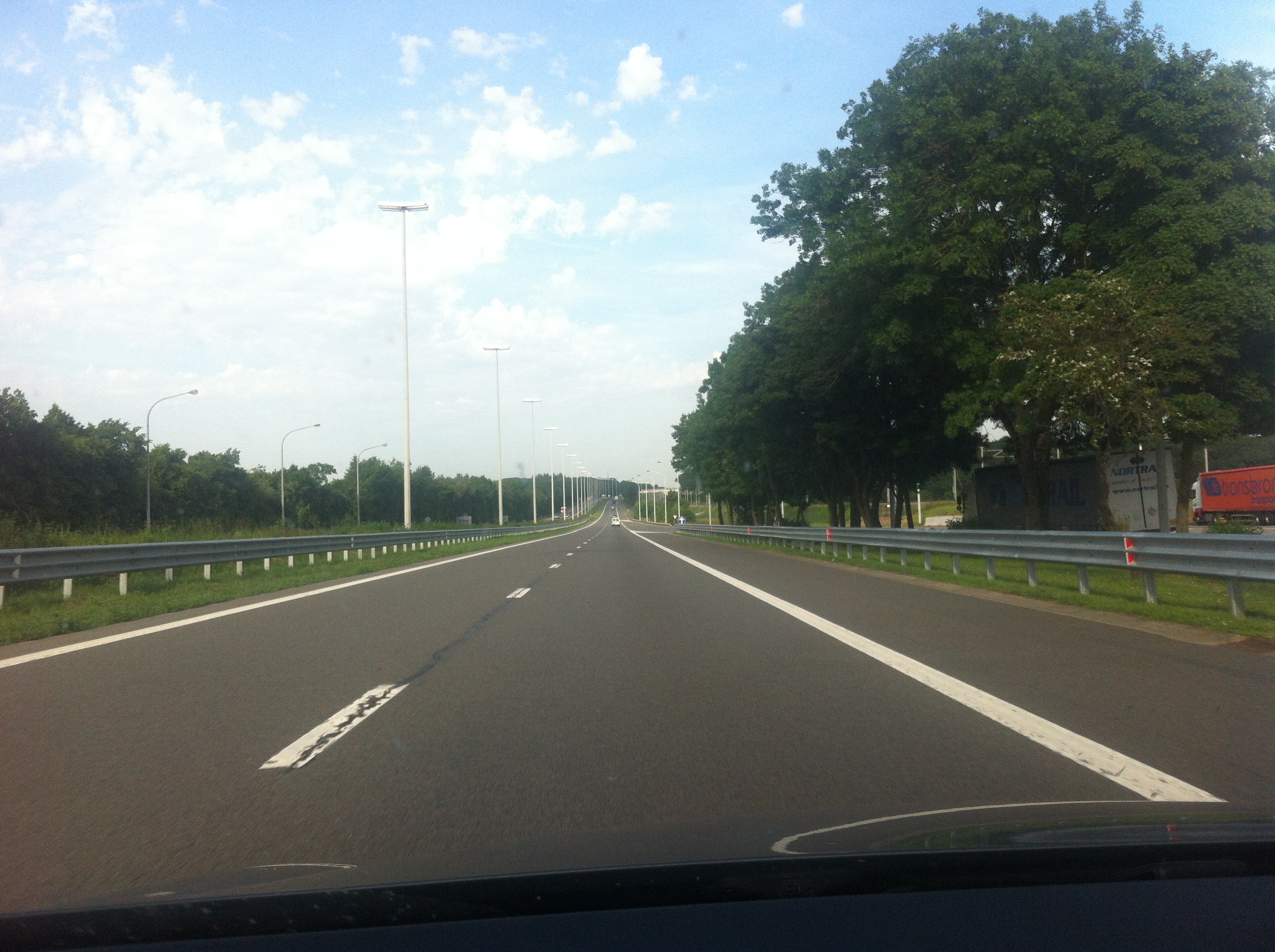 Controlled-access motorwayLendert Van Laer · CC BY-SA 3.0 ↗
 HighwayPublic domain · AWV ↗
Highway
Begins at its own sign. Junctions and traffic lights may be present.
 MotorwayPublic domain · AWV ↗
Motorway
Begins at its entrance sign. No level junctions or traffic lights.
FeatureMotorwayHighway
Normal minimum70 km/hNo special minimum
General maximum for a car120 km/hRegional and road-layout rules apply
Level junctions / traffic lightsNoPossible
How the rule startsEntrance signEntrance sign
Part 2
Motorway speed rules
For a car, 120 km/h is the general maximum and 70 km/h is the normal minimum. A posted or lane-control signal can impose a lower limit, and every driver must reduce speed whenever traffic, visibility or road conditions require it.
 Lane-control signalsThomas Vlerick · CC BY 2.0 ↗
General maximum120km/h
Normal minimum70km/h
Part 3
Lane discipline and overtaking
Keep as far right as possible. Move left to overtake and return right when it is safe. Direction signs, lawful lane selection inside built-up areas and lawful motorcycle filtering rules can change how lanes are used.
 Read the lane markingsWolfgang Weiser · Unsplash ↗
Check mirrors and blind spot, signal, pass safely and return right.
Maximum 50 km/h, no more than 20 km/h faster than traffic, between the two leftmost lanes.
The hard shoulder is not an extra traffic lane.
Motorcycle filteringRuleMeaning
Maximum speed50 km/hThe rider may not filter faster than 50 km/h.
Speed differenceMaximum 20 km/hThe motorcycle may travel no more than 20 km/h faster than the traffic being passed.
Filtering positionTwo leftmost lanesFilter between the two lanes furthest to the left—not between any convenient pair.
Part 4
Joining and leaving a motorway
Use the entry lane to build a safe speed, signal left and find a safe gap. Changing lane is a manoeuvre, so traffic already on the motorway has priority. When leaving, signal right, enter the exit lane and then adjust to the posted limit and the curve.
 Joining and leavingJose Manuel Esp · Unsplash ↗
1Observe
Check mirrors, traffic speed and the available gap.
2Match safely
Build an appropriate speed without exceeding the applicable limit.
3Signal and yield
Indicate left and give way to traffic already on the motorway.
4Merge smoothly
Enter the gap without forcing another driver to brake or change lane.
Give way when joining. Traffic already travelling on the motorway or highway has priority. Merge only when there is a safe gap.
Part 5
Zipper merging
The zipper rule applies when traffic is seriously slowed and a lane ends or is blocked. Drivers in the closing lane stay in it until just before the narrowing; the open lane then lets one driver merge at a time.
 Merge at the narrowingJulia A. Keirns · Unsplash ↗
ContinueUse both lanes
Stay in your lane while approaching the narrowing.
At the endMerge late
Change lane just before the obstruction or lane end.
One by oneAlternate
The open lane gives way to one merging driver.
SituationCorrect order
One lane closesOne vehicle from the open lane, then one from the closing lane.
Both outer lanes closeThe open middle lane first lets one vehicle merge from the right, then one from the left.
When both outer lanes close
1Right merges
→2Left merges
→3Middle continues
Part 6
Actions that are prohibited
These rules apply on motorways and, where the code extends them, on highways.
Follow the permitted directionWolfgang Weiser · Unsplash ↗No U-turn
Never use a central crossover to turn around.
No reversing
Do not reverse, even after missing an exit.
No wrong-way driving
If you enter against traffic, stop safely, use hazard lights and call emergency services.
No ordinary towing
Emergency or auxiliary-coupling towing is prohibited on the motorway.
No stopping or parking
On a motorway, stop only where authorised or when an emergency makes it unavoidable.
No shoulder driving
Only authorised emergency and recovery traffic may use it in the specified circumstances.
Part 7
Who may enter?
Motorways exclude pedestrians, cyclists, mopeds, animal traffic, agricultural vehicles, motor quadricycles without a passenger compartment and vehicles unable to reach 70 km/h on a level road.
Motorway accessLendert Van Laer · CC BY-SA 3.0 ↗May enter
A road-legal car capable of reaching at least 70 km/h on a level road, unless another restriction applies.
May not enter
Pedestrians, bicycles, mopeds, animals, agricultural vehicles and vehicles that cannot reach 70 km/h.
Part 8
Breakdown, warning triangle and rescue lane
Move out of the traffic lanes if possible, activate the hazard lights and warn approaching traffic. If you leave a vehicle stopped where stopping is prohibited on a motorway or highway, wear a reflective safety vest.
Create distance from trafficJulia A. Keirns · Unsplash ↗SituationRule to remember
Warning triangle · motorwayAt least 100 metres behind the vehicle.
Warning triangle · ordinary roadAt least 30 metres behind the vehicle.
Warning triangle · visibilityPosition it so approaching drivers can see it from about 50 metres away.
Leaving the vehicleWear the reflective vest when stopped where stopping or parking is prohibited on a motorway or highway.
Traffic queueCreate a rescue lane: left lane moves left; every other lane moves right.
This chapter is study guidance, not legal advice. Current signs, authorised directions and official rules always take priority.
Exam memory
Essential motorway decisions
F5 begins a motorway; F9 begins a highway. Do not infer the road type from its appearance.
For a car on a motorway: general maximum 120 km/h and normal minimum 70 km/h. Signs, congestion and safety conditions can require less.
Overtake on the left and return right when safe. The hard shoulder is not an ordinary lane.
Wear your vest before leaving. Place the triangle at least 100 m behind on a motorway when safe, visible from 50 m.
Use the disappearing lane until the merge point; continuing traffic lets one vehicle in at a time.
Continue to the next exit. Never reverse, turn around or drive against the traffic.
Fixed assessment
20-question chapter test
Select an answer for immediate feedback and a clear explanation.
0/20 answered · Select an answer to see the explanation immediately.